Why I Built ALTOS: Bringing Automation to Philippine Local Treasuries
A treasury system built around one idea: every peso should be accounted for from the moment it arrives to the moment it is reported.
Walk into many local treasury offices in the Philippines and you will still see stacks of receipts, hand-ruled cash books and monthly reports added up with a calculator. The people doing this work are careful and dedicated, but paper has limits. Reports take days to prepare, and a single wrong figure can hide for months before anyone notices.
I have spent more than 13 years in local government fiscal administration, and I kept asking the same question: what if the office's own rules were built into the tools it uses every day? That question became ALTOS, the Automated Local Treasury Operations System.
The Idea Behind It: Close the Circle
Picture the life of a single peso in a local treasury. It is received, recorded, deposited, perhaps paid out, and finally reported. At each of those stops, someone should be responsible for it. If even one stop has no clear owner, that is where errors and losses tend to happen.
Accountability has to go all the way around. A circle with a missing piece is not a circle, and public money slips out through the missing piece.
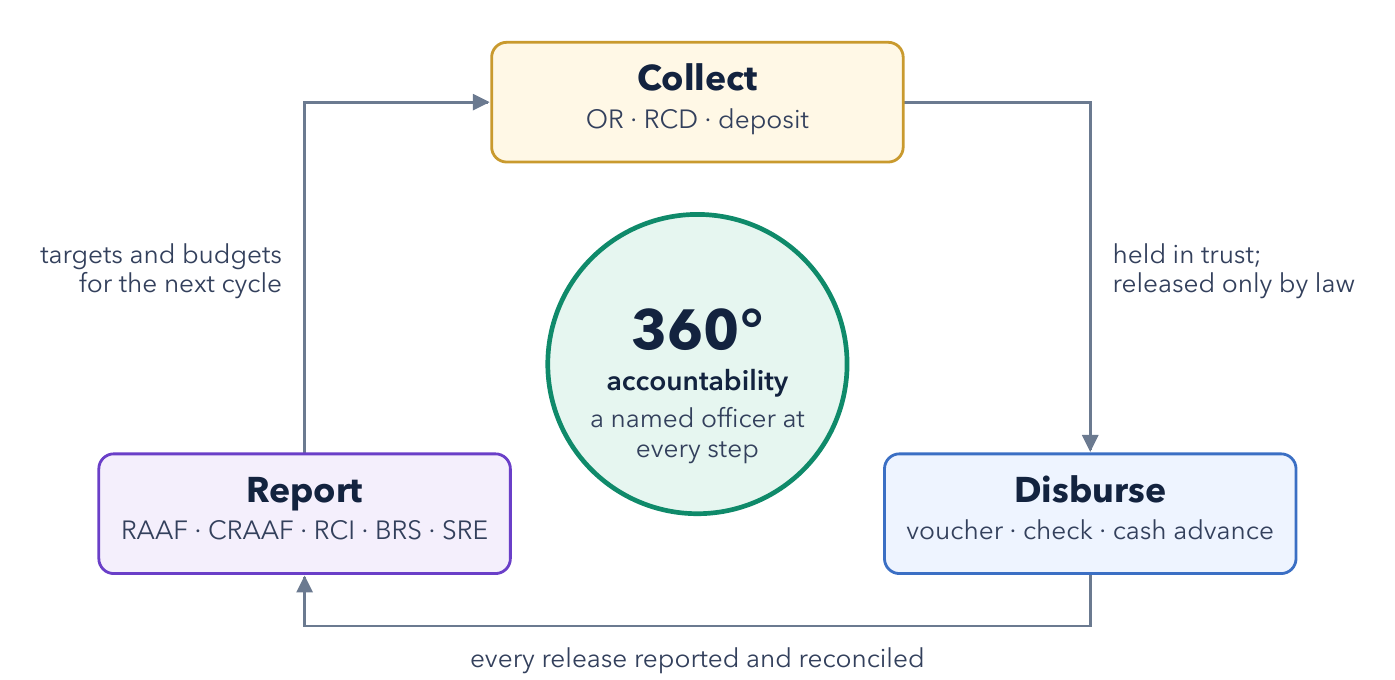
This is why I describe ALTOS as 360° accountability. Treasury work moves in a cycle of three steps: money comes in, money goes out, and both are reported. The reports then guide next year's targets and budget, and the cycle begins again.
Starting From Forms People Already Know
I did not want treasury staff to learn a strange new way of working. So every screen in ALTOS follows an official form they already fill out, from the LTOM and the COA. An auditor looking at the system sees the same documents they would see on paper.
The system also enforces the rules quietly in the background. Receipts are numbered strictly in sequence, so none can go missing. A check cannot carry a date earlier than its checkbook. The 20% Development Fund and other Trust Funds are always set aside. And because the RAAF and CRAAF are due on the 5th of each month, ALTOS shows a countdown so the officer and the supervisor both know how many days are left.
Two Subsystems, Both Ready
ALTOS is the main system, and it now has two working subsystems. The Treasury Collection System covers everything on the receiving side: official receipts, collectors and their receipt series, remittances, bank deposits, the daily report of collections, and the monthly accountability reports. The Treasury Disbursement System covers the paying side: vouchers, checks, cash advances and their liquidation, the check register, and disbursement reports. Both share one database, which can be used from a desktop application or a web browser anywhere on the office network.
A Record You Can Trust
A treasury's records are only as good as their protection against tampering. In ALTOS, each entry in the activity log is digitally linked to the one before it, much like links in a chain. If anyone deletes or alters an entry, the break in the chain shows. Mistakes can still be fixed, but only through a recorded correction that states who made it and why.
Security follows the NIST Cybersecurity Framework, an internationally used guide. Passwords are stored in scrambled form, accounts lock after repeated wrong attempts, idle sessions close on their own, and backups are encrypted and tested to make sure they can actually be restored.
Made to Last Beyond Its Builder
Treasurers are transferred, retire or move on. A good system should keep working after they leave. That is why ALTOS has a turnover feature that gathers and checks the office's records and prepares a certificate for the next treasurer.
Adoption Needs a Policy That Protects the Builder
ALTOS is not a demo or a school project. It runs on real collections and real disbursements, and the reports it produces are the ones an office signs and submits. When an office adopts a system like this, the system becomes part of how public money is handled, and that calls for clear rules on paper.
Without those rules, the builder carries risks that nobody else sees. The system can be copied or changed without the builder's knowledge. The builder can be expected to fix problems at any hour, for free, long after leaving the office. Credit for the work can quietly disappear. And if something goes wrong because of a change someone else made, the builder can still be the one blamed.
There is also a legal question. Under the Intellectual Property Code (RA 8293), there is no copyright in a work of the Government, meaning a work an official creates as part of regularly prescribed duties. Writing software is not among a treasurer's duties under the law, but the answer in each case depends on the facts and on what the parties agree in writing. That is exactly why the agreement has to come first.
What a Good Adoption Policy Covers
Proof of authorship. A dated record of the source files, design notes and versions that shows who built the system and when.
Registration. Where appropriate, registration or deposit of the work with the Intellectual Property Office of the Philippines (IPOPHL).
A written agreement. A memorandum of agreement or license that states what the office may and may not do with the system: how it may be used, who maintains and hosts it, who may change it, and what happens when the builder is transferred, retires or resigns.
Clear ownership of the data. The office's records belong to the office and must always be available to it and to auditors, while the software itself remains the builder's work.
Fair responsibility. The builder answers for the system as delivered, not for changes made by others or for how it is operated after turnover.
Legal review. Advice from legal counsel before signing, and before any commercial use.
A clear agreement is not a sign of distrust. It is how both sides keep their promises: the office keeps a working system and its records, the builder keeps the authorship, and taxpayers keep uninterrupted service.
I am also putting the thinking behind ALTOS into a book, 360° Accountability: Public Fiscal Administration in Philippine Local Treasuries. It closes with ten principles that any local treasury can follow, whether or not it uses software. I will write about each of them here.
Every peso, every step, every officer: 360°.